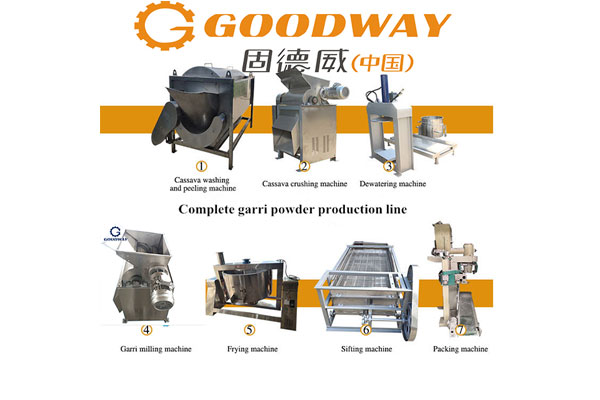
The tapioca starch production process varies based on automation and quality needs, with options for fully automated mechanized processing or semi-manual + mechanical methods for small-scale operations. The difference lies in the processing time and the simplification of processing steps. Edible cassava starch is divided into grades. For this reason, the configuration and price of cassava starch processing equipment are also graded.
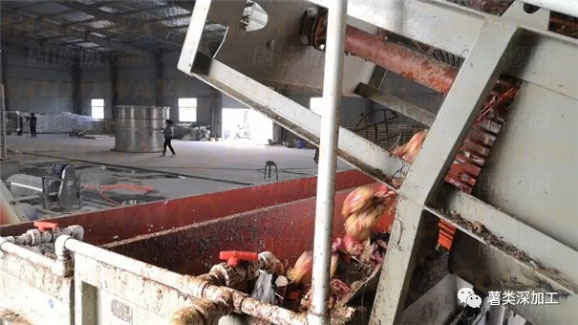
The more automated cassava starch processing equipment produces cassava starch with high precision and purity, which can reach industrial level, and is more used in the pharmaceutical and chemical industries. Such wood starch processing equipment is also more expensive, and the basic complete sets of equipment are high-configuration. The price is around 500,000-1 million.
Starch processing users in small starch factories and farmer workshops on the market that mainly process coarse starch can choose to configure medium-sized practical and economical tapioca starch processing equipment. The investment is not too large, and it is expected to be between 100,000 and 200,000. The precision of this starch is not particularly high, but it can achieve the quality requirements of no adulteration, no taste, white color, and fine and uniform quality. It is also sufficient for ordinary processing households' edible starch.
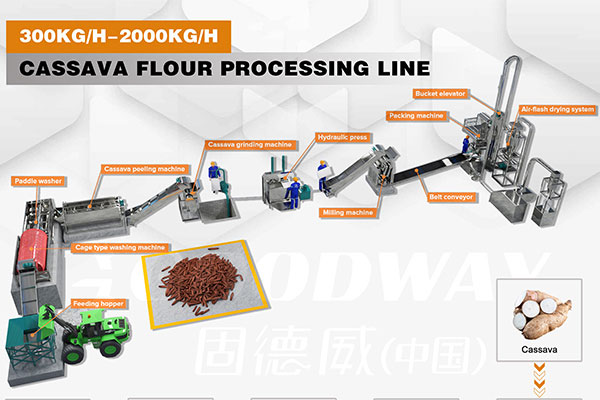
The process of tapioca starch processing is: cleaning-crushing-filtering purification-degreasing and desilting-concentration and refining-vacuum dehydration-drying.
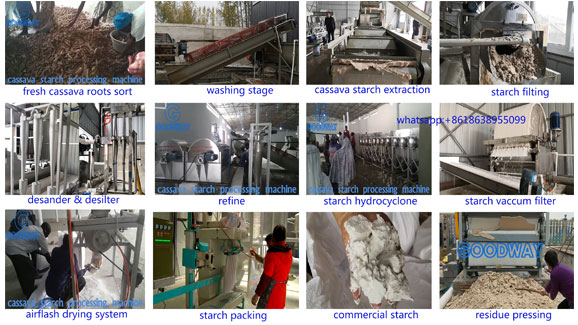
The above is the process flow of a complete set of tapioca starch processing equipment. If it is a simple processing, there is no need for so many processing processes. Corresponding starch equipment can be used less. Basically, only washing-crushing-sedimentation is used, and the follow-up is Manual drying.
Of course, because everyone’s actual processing conditions are different, and the requirements for starch quality and the degree of automation of starch processing equipment are different, there are many options for the configuration and quantity of starch processing equipment. They can be equipped with only crushing and filtering equipment, or you can Just don't need a starch dryer, these are all okay. It is based on your purchase requirements plus reasonable suggestions to support starch processing equipment. The specific Goodway can be customized and flexibly matched.
The complete set of tapioca starch processing equipment includes the following types:
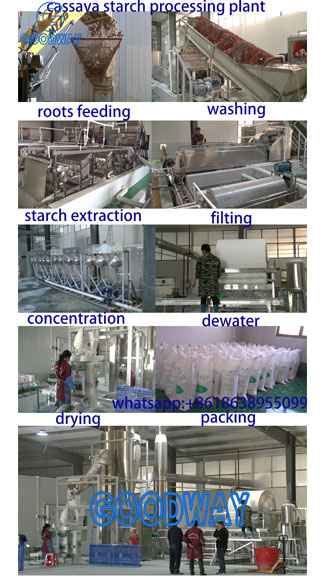
1. Cassava cleaning machine: different cleaning methods can be divided into dry cleaning machine, rubbing washing machine, conveyor cleaning machine
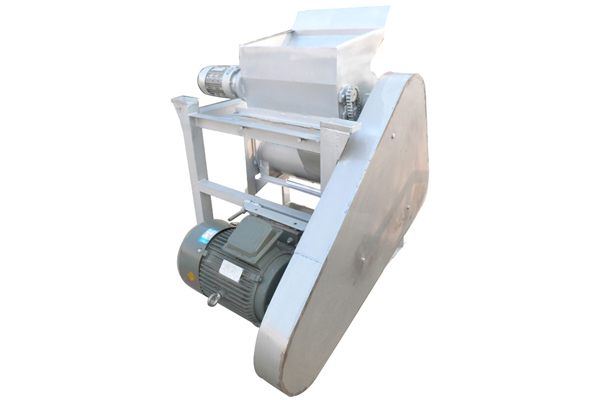
2. Cassava crushing equipment: curved net extrusion type flour mill and overflow washing type flour mill
3. Starch filtration equipment: fine filter, micro filter, centrifuge
4. Starch purification and impurity removal equipment: desander, desilter
5. Starch separation equipment: cyclone station
6. Starch dehydrator: vacuum dehydrator
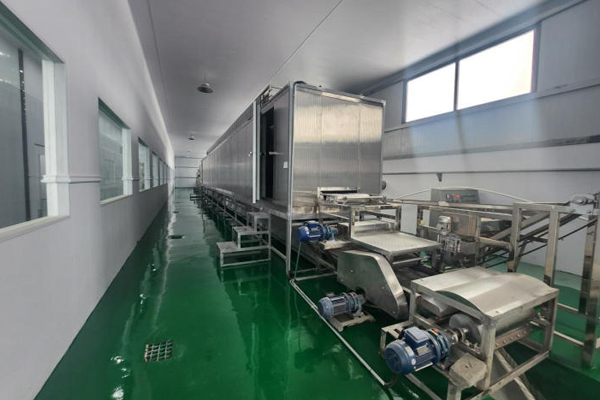
7. Starch dryer: air-flow dryer
Investment Comparison: Tapioca Starch Processing Scales
Selecting the right configuration is crucial for your business ROI. We have categorized the tapioca starch processing machinery into three levels based on automation, starch purity, and investment budget:
|
Processing Scale
|
Starch Quality & Automation
|
Estimated Investment
|
Primary Target Market
|
|
Small-Scale Workshop
|
Coarse Starch: Semi-manual + basic mechanical crushing. Low automation.
|
$15,000 - $30,000
|
Local food markets, traditional snacks, and home use.
|
|
Medium-Sized Factory
|
Standard Grade: High-purity edible starch. Practical & economical configuration.
|
$45,000 - $75,000
|
Regional food processing industries, bakeries, and wholesale.
|
|
Large Industrial Plant
|
Pharma/Chemical Grade: Fully automated, high-precision purification & instant drying.
|
$100,000 - $150,000+
|
International export, pharmaceutical, and high-end chemical industries.
|
Pro Tip: The investment cost is influenced by the required output capacity (tons per hour) and the specific material of the machines (Carbon Steel vs. Food-Grade Stainless Steel). GOODWAY provides customized equipment lists to match your specific budget and quality standards.
Tapioca Starch Machinery & Investment: Frequently Asked Questions
Q1: What is the average price of a complete tapioca starch production line?
A: The investment cost for tapioca starch processing machinery depends largely on the level of automation and daily capacity.
Small-scale setups: Typically range from $15,000 to $30,000, suitable for farmer workshops.
Fully automated industrial lines: High-precision production lines designed for the global market can cost between $80,000 and $150,000+ (roughly 500,000 to 1,000,000 RMB). This includes advanced systems for extraction, refining, and flash drying.
Q2: Can I start with a simple processing line and upgrade to automation later?
A: Yes, absolutely. GOODWAY offers modular cassava processing equipment designed for scalability. Many of our clients start with a basic "Practical Mix" (Washing + Crushing + Sedimentation). As your business grows, you can seamlessly integrate a starch hydrocyclone station to improve purity or a flash starch dryer to replace manual drying, significantly increasing your production efficiency and starch grade.
Q3: What is the difference between industrial-grade and edible-grade starch processing?
A: The primary difference lies in purity and fiber content.
Industrial/Pharma Grade: Requires advanced refining via multi-stage cyclone stations and vacuum dewatering to ensure zero impurities and precise moisture control.
Edible Grade: Often used in local food markets, this can be produced using medium-configuration equipment that focuses on whiteness and texture without the extreme filtration required for chemical or pharmaceutical applications.
Q4: How much space is required to install a complete tapioca starch plant?
A: A small-scale workshop may only require 100-200 square meters, while a medium-to-large automated factory typically needs 500 to 1,500 square meters to accommodate the full machinery line, including cleaning areas, the processing workshop, and the finished product warehouse. GOODWAY provides custom factory layout designs based on your specific site dimensions.
Q5: Why choose GOODWAY as your tapioca starch machine manufacturer?
A: With over 27 years of expertise and 35 national patents, GOODWAY provides more than just machinery. We offer a "Turnkey Solution" that includes equipment customization, installation guidance, and lifetime technical support. Our machines are engineered to maximize starch extraction rates from cassava roots, ensuring the highest ROI for your investment.
 EN
EN
 fr
fr  es
es  it
it  pt
pt