In 2026, Africa's cassava industry continues to grow rapidly, driven by demand for starch, garri, flour, and chips. However, traditional manual harvesting remains a major bottleneck — labor-intensive, time-consuming, and prone to root damage and post-harvest losses.
Mechanizedcassava harvester machinescombined with modern processing lines offer a proven solution. Goodway Machinery's integrated equipment helps processors and farmers across major African cassava regions — including Nigeria, Ghana, Cameroon, and many other countries — achieve substantial overall efficiency gains, often 30-40% or more, by streamlining the entire chain from field to final product.
Why Cassava Harvesting Is the Critical First Step in 2026
Cassava roots must be harvested at peak starch content (usually 12–15 months after planting). Manual digging is slow and damages roots, leading to spoilage and reduced starch yield.
A dedicatedcassava harvester machinechanges this:
·High capacity— Models like Goodway GD4U series harvest3–7 acres per hourdepending on configuration (single or double row).
·Low breakage rate— Adjustable working depth (15–25 cm) and gentle lifting minimize root damage.
·Versatility— Suitable for cassava, potato, sweet potato, and other tubers; also removes mulching film automatically.
·Power options— Compatible with 15–50 HP tractors, making it accessible for small-to-medium farms and large plantations.
By reducing harvesting time and labor, farmers can supply fresher roots to processing plants, directly improving starch extraction rates and final product quality.
Learn more about Goodway's Cassava Harvesting Machine.
How Cassava Harvester Integrates with Full Processing Lines
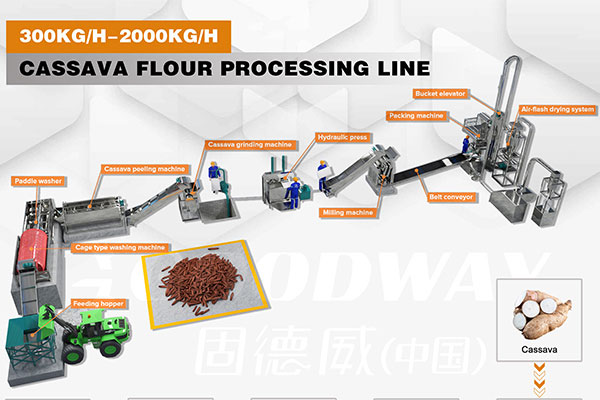
The real power comes fromend-to-end integration. A Goodway cassava harvester feeds directly into a complete processing line, eliminating delays and manual handling.
Typical integrated workflow:
1.Harvesting→ Fresh roots collected with minimal damage.
2.Transportation & Washing→ Cassava washing machine or paddle washer removes soil.
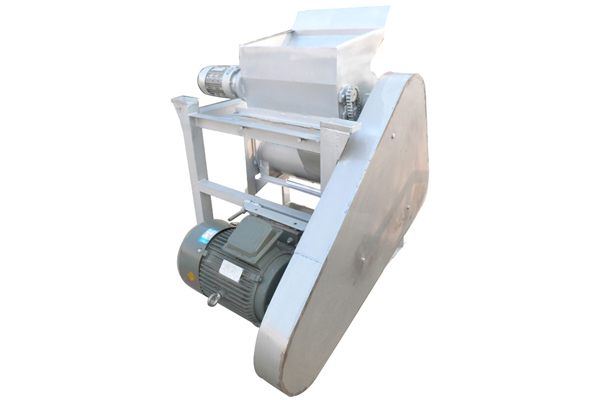
3.Peeling & Crushing→ Cassava peeling machine + rasper or curved mesh crusher for high-efficiency grating.
4.Starch Extraction→ Centrifugal sieve, hydrocyclone, and desander for pure starch slurry.
5.Dewatering & Drying→ Hydraulic dewatering press + airflow flash dryer for low-moisture final product.
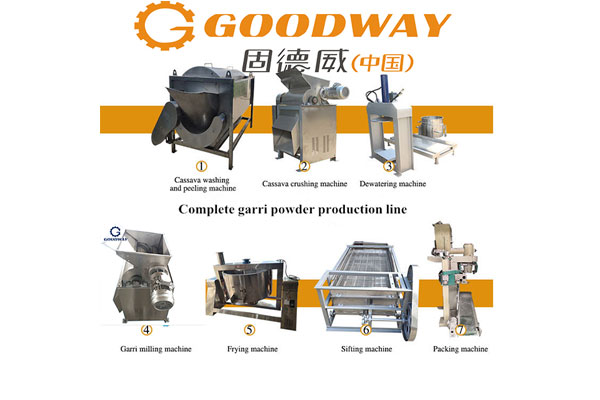
6.Further Processing→ Garri fryer for garri, milling for flour, or packaging for starch.
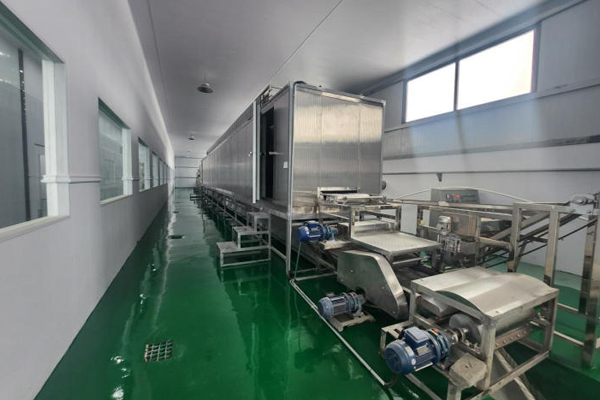
This seamless chain reduces labor costs, minimizes contamination, and boosts throughput. Turnkey projects from Goodway (starch, flour, or garri lines) are customized for capacities from 500 kg/hour to 200 tons/day, with proven installations across Africa.
Explore complete Cassava Processing Machine solutions.
Efficiency Gains and ROI in African Context (2026 Outlook)
Mechanization of harvesting and processing delivers measurable benefits:
·Yield improvement— Up to 38% higher effective yieldper hectare when combined with good agronomic practices.
·Labor savings— One machine replaces dozens of manual workers, critical in regions facing labor shortages.
·Reduced losses— Lower root damage and faster field-to-plant transfer cut post-harvest spoilage.
·Higher starch/flour quality— Fresher roots mean better extraction rates and whiter, higher-value products.
·Scalability— Suitable for both smallholder cooperatives and commercial plants targeting local garri markets or export starch.
In Nigeria and Ghana, where garri and cassava flour demand remains strong, integrating a harvester with a garri processing line or starch plant can significantly shorten payback periods. Goodway's Africa-focused projects (e.g., in Nigeria, Ghana, Cameroon) demonstrate reliable performance under local soil and climate conditions.
See real success stories in our Africa Cassava Processing Cases.
Choosing the Right Cassava Harvester for Your 2026 Project
Key factors to consider:
·Farm size & row spacing— Choose single-row (GD4U-600) or double-row (GD4U-800/900) models.
·Tractor compatibility— Match horsepower requirements.
·Soil type— Adjustable depth ensures performance in varied African soils.
·Integration readiness— Goodway machines are designed to pair with downstream washing, peeling, and extraction equipment.
For investors planning a new plant in 2026, starting with a harvester + processing line package ensures the entire operation runs smoothly from day one.
Compare Cassava Grater Machine and other key equipment.
Take the Next Step Toward Modern Cassava Processing
2026 is an ideal year to invest in mechanized cassava solutions. With rising demand for value-added cassava products and government support for agri-processing in many African countries, an integrated harvesting and processing system offers strong returns while modernizing operations.
Goodway Machinery, based in Nanyang, China, specializes in turnkey cassava projects tailored for African markets. Our equipment combines high efficiency, durability, and competitive pricing with excellent after-sales support.
Ready to boost your cassava operation efficiency from field to factory?
Contact Goodway today for a customized quotation, factory layout, or visit to our showroom. Let us help you build a profitable, future-ready cassava processing business in 2026.
 EN
EN
 fr
fr  es
es  it
it  pt
pt