For industrial cassava chips production, slicing is not simply a cutting step. The thickness and consistency of fresh cassava slices affect downstream drying, handling, and final product quality. A properly selected cassava slicer machine should therefore be evaluated together with production capacity, blade adjustment, feeding conditions, and the drying stage. For processors moving from manual preparation to continuous production, these factors help create a more stable cassava chips process.
What Is a Cassava Slicer Machine for Industrial Chips?
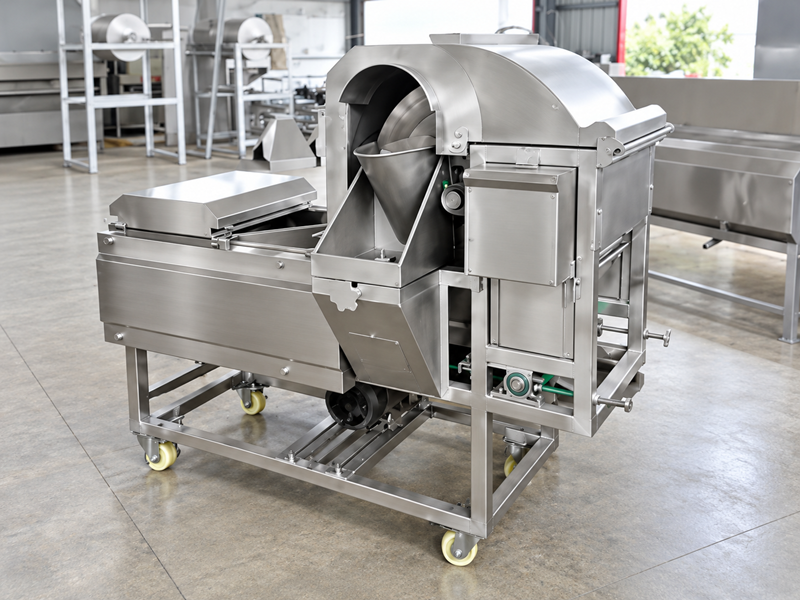
A cassava slicer machine cuts peeled cassava roots into relatively uniform chips before drying. In an industrial line, the slicer connects the preparation stage with subsequent drying and packaging operations, so its performance affects the consistency of the material entering the dryer.
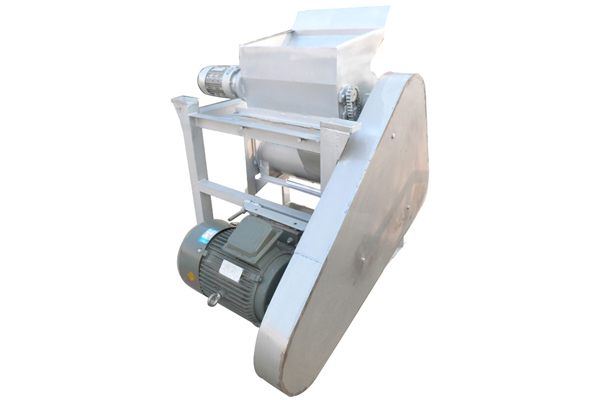
The cutting mechanism needs to handle fresh cassava roots efficiently while maintaining the required chip dimensions. GOODWAY's industrial cassava cutting equipment uses rotating cutter blades and provides adjustable chip thickness, with listed models covering different production capacities.
For industrial buyers, the important question is not simply whether a machine can cut cassava, but whether its output characteristics match the requirements of the entire production line.
How Cut Thickness Affects Cassava Chips Quality and Drying
Chip thickness directly influences how quickly moisture can leave the cassava during drying. If slices vary significantly in thickness, thinner pieces may dry earlier while thicker pieces retain more moisture. This can make it harder to achieve consistent moisture levels across the finished product.
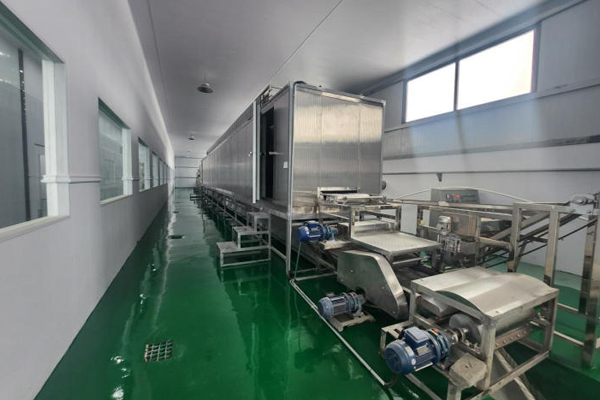
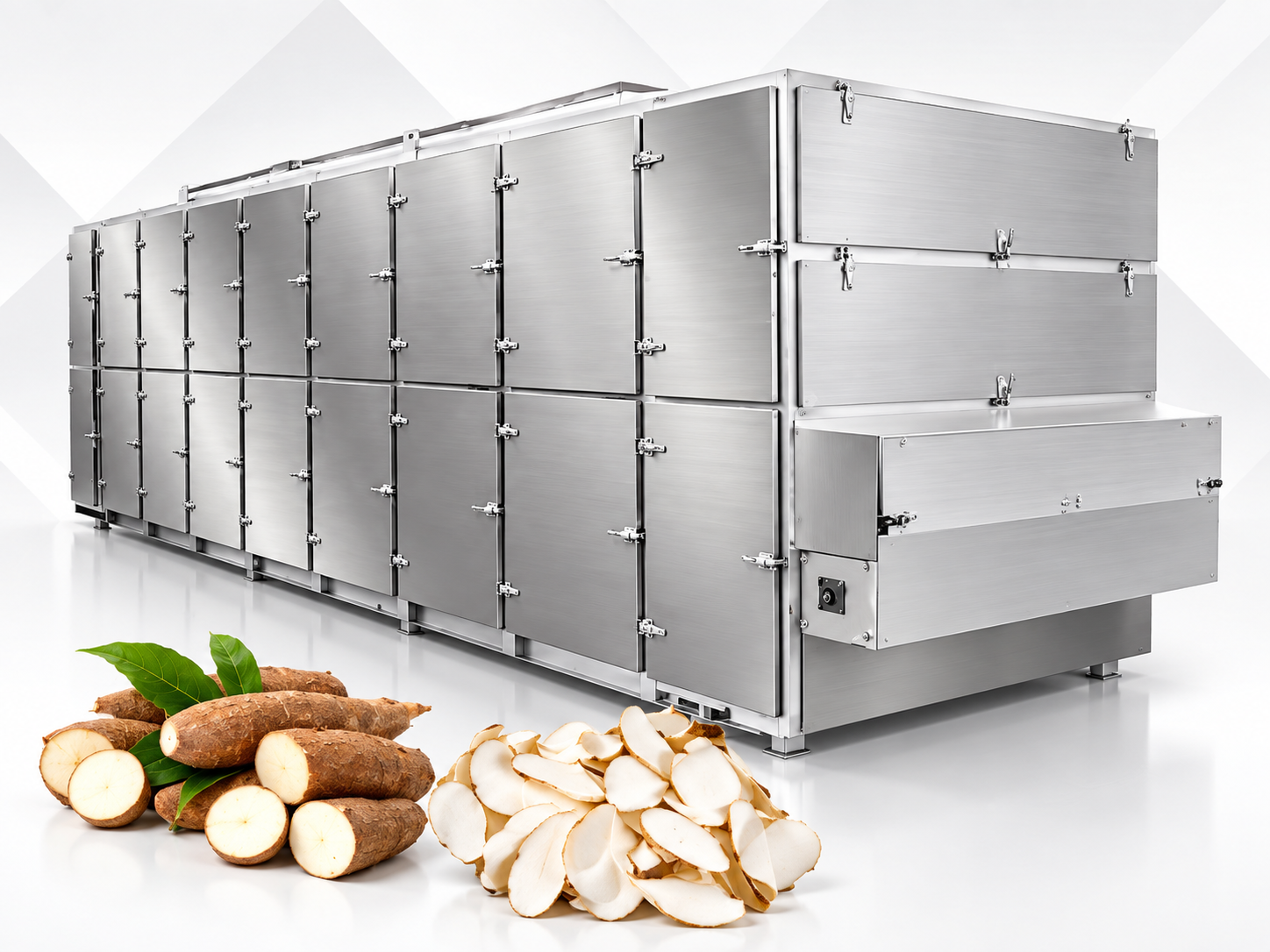
A cassava chips drying machine should therefore be considered together with the slicer rather than selected as a completely separate process. The cutting stage determines the physical size of the wet material entering the drying stage, while the dryer removes moisture through controlled heat transfer.
When setting the cutting specification, processors should consider:
Target chip thickness: Different applications may require different slice dimensions, so adjustable cutting is useful when production specifications change.
Thickness consistency: Uniform slices provide a more predictable material condition for downstream drying.
Drying capacity: The slicer and dryer should process compatible quantities to avoid accumulation between stages.
Final moisture requirements: Cutting dimensions should be evaluated together with the intended drying conditions and final product specification.
GOODWAY lists an adjustable thickness range of 5–20 mm for its cassava chips cutting equipment, although the appropriate setting should be determined according to the specific product and process requirements.
How to Match Slicer Capacity with the Production Line
Machine capacity should be evaluated according to the actual production target rather than choosing the largest available model. A slicer that substantially exceeds the capacity of the following drying stage may create unnecessary accumulation, while an undersized cutter can restrict the throughput of the entire line.
GOODWAY currently lists cassava cutting models ranging from approximately 800–1,000 kg/h to 7,000–10,000 kg/h, providing different capacity levels for different production requirements.
| Model | Listed Capacity | Motor Power |
| G-CS1000 | 800–1,000 kg/h | 2.2–3.0 kW |
| G-CS3000 | 2,000–3,000 kg/h | 5.5–7.5 kW |
| G-CS5000 | 4,000–5,000 kg/h | 11.0–15.0 kW |
| G-CS8000 | 7,000–10,000 kg/h | 18.5–22.0 kW |
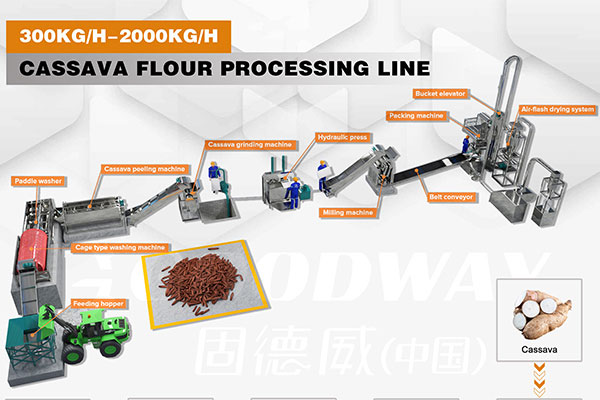
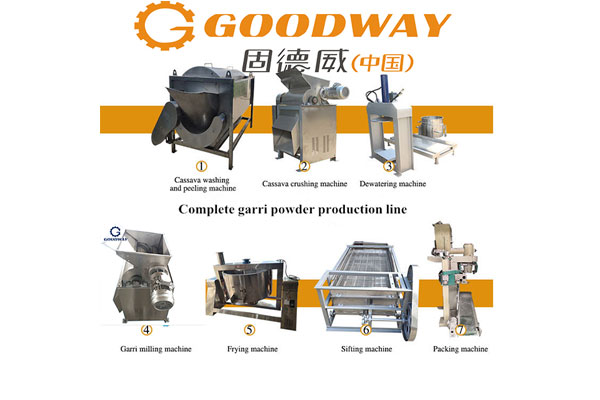
These figures illustrate why capacity should be considered at the production-line level. The washing, peeling, cutting, drying, and packaging stages need to work together rather than being sized independently. GOODWAY describes cassava chips processing as a sequence including washing, peeling, slicing, drying, and packaging.
Cassava Slicer Machine Selection: Blade, Feed and Material Factors
Blade configuration and feeding conditions influence cutting consistency and machine operation. Buyers should evaluate the expected cassava root size, required slice thickness, working hours, cleaning requirements, and available power supply before confirming a model.
A tapioca chips cutting machine can be considered when the project uses cassava under the broader tapioca-processing category. For industrial procurement, the following factors deserve particular attention:
Blade adjustment: Confirm whether the required thickness can be achieved and adjusted during production.
Feeding arrangement: Check whether the machine's inlet and feeding method suit the upstream peeling or preparation equipment.
Contact materials: Food-contact components should be appropriate for continuous agricultural-food processing.
Power configuration: Confirm voltage, motor requirements, and whether alternative power options are needed for the installation location.
Maintenance access: Blade replacement, cleaning, and routine inspection should be practical for the operating environment.
The manufacturer's published specifications also indicate customized motor voltages and diesel-engine options for different regional power conditions.
How to Build a Consistent Cassava Chips Production Workflow
A consistent workflow starts by treating slicing as part of the complete processing system. Fresh cassava should first be properly cleaned and peeled before entering the cutting stage. After slicing, the material should move efficiently into drying without excessive waiting or uncontrolled accumulation.
A complete how to produce cassava chips workflow can include cleaning, peeling, cutting, drying, and packaging. Matching the throughput of each stage helps maintain a more predictable production rhythm.
For a new project, buyers should define the desired output, raw cassava condition, target chip thickness, drying method, operating schedule, available utilities, and packaging requirements before selecting individual machines. This gives the equipment supplier enough information to recommend a coordinated configuration rather than treating the slicer as an isolated machine.
Conclusion
Choosing a cassava slicer machine for industrial chips production involves more than comparing nominal capacity. Cut thickness, consistency, blade configuration, feeding, power supply, and downstream drying capacity all influence the final process. A slicer should therefore be selected as part of a complete production workflow, with its output matched to the requirements of drying and packaging. This approach can help processors achieve more stable throughput and more consistent cassava chips quality.
FAQ: Cassava Slicer Machine Selection
What thickness can a cassava slicer machine produce?
GOODWAY lists an adjustable thickness range of 5–20 mm for its cassava chips cutting equipment. The appropriate setting depends on the intended product and drying requirements.
How do I choose slicer capacity?
Start with the required finished production output and compare the capacities of the cutting and drying stages. The bottleneck stage should be considered when sizing the line.
Does chip thickness affect drying?
Yes. Slice thickness influences the distance moisture needs to travel during drying, so inconsistent thickness can contribute to uneven drying.
Can cassava slicers be integrated into a complete line?
Yes. Industrial cassava processing can connect washing, peeling, slicing, drying, and packaging into a coordinated workflow.
 EN
EN
 fr
fr  es
es  it
it  pt
pt