Choosing the right starch flash dryer is mainly a capacity and moisture-removal problem. A dryer rated for 1,000 kg/h of finished starch does not necessarily handle 1,000 kg/h of wet feed, because the amount of water entering the system changes the evaporation load.
For starch processors, the key sizing inputs are wet-feed rate, initial moisture, required final moisture, operating hours and heat source. Air temperature, airflow and residence time must then be balanced so the dryer removes enough moisture without overheating or degrading the starch.
What Is a Starch Flash Dryer and When Should You Use One?
A starch flash dryer suspends wet starch particles in a high-velocity stream of hot air so moisture is removed within a very short contact time.
Flash drying is particularly useful for fine, heat-sensitive powders because particles remain in the hot-air stream only briefly. Goodway publishes a material contact time of approximately 1–5 seconds for its starch drying system, with typical wet-starch moisture of 35–40% and final moisture of about 12–14%.
Goodway's airflow system is used for cassava, potato, sweet potato and other starches. Its published processing range extends from approximately 100 to 2,000 kg/h, making flash drying suitable for both medium and larger commercial production lines.
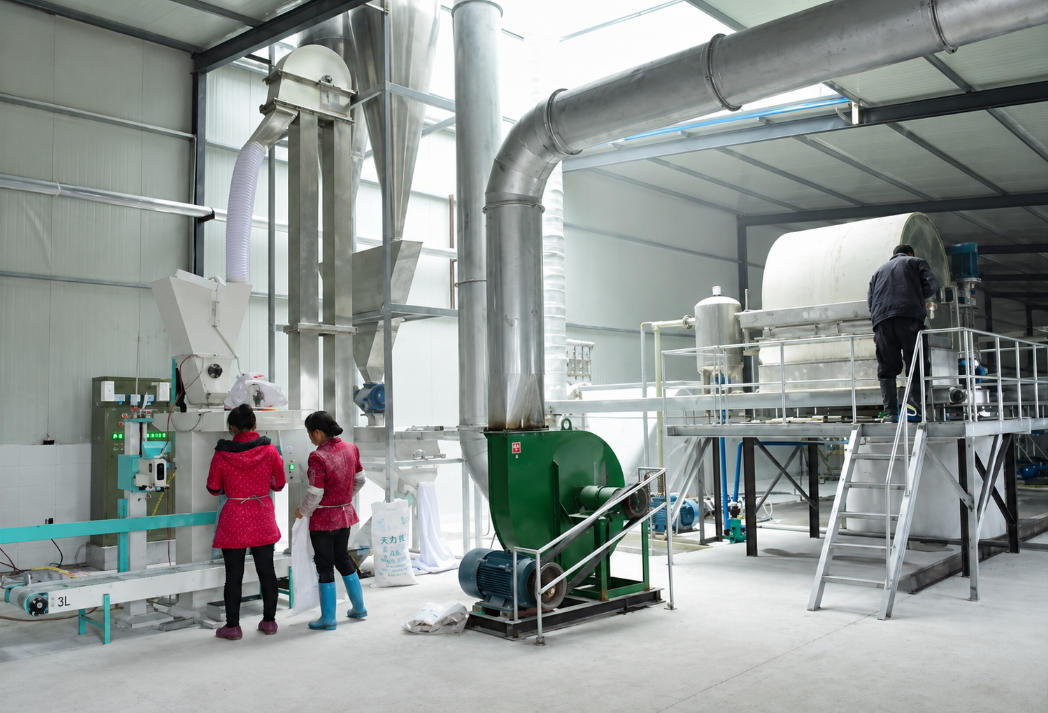
How Feed Moisture Affects Flash Dryer Capacity
Feed moisture affects starch dryer machine capacity because wetter material requires the dryer to evaporate more water for every kilogram of finished product.
Consider two wet feeds entering the same dryer. If one contains 35% moisture and the other 40%, the second feed carries more water even when the wet-feed rate is identical. That additional water must be heated and evaporated, increasing thermal load.
This is why upstream dewatering is important. A centrifuge, vacuum filter or other dewatering stage that reduces wet-starch moisture can significantly reduce the load on the flash dryer.
Goodway specifies wet starch below about 40% moisture for its airflow flash dryer. If incoming moisture varies widely during production, the dryer should be sized for the realistic upper range rather than only the average.
How to Calculate the Required Dryer Capacity
The required air flow flash dryer capacity should be calculated from both finished-product output and the amount of water that must be removed per hour.
A useful first calculation is:
Water evaporation load = Wet feed × initial moisture − dry product × final moisture
For a quick sizing example, assume 1,000 kg/h of wet starch at 40% moisture. That feed contains approximately 600 kg/h dry solids. If the final product is targeted at 13% moisture, finished output is roughly 690 kg/h, so approximately 310 kg of water per hour must be evaporated.
| Sizing Input | Example |
|---|
| Wet feed | 1,000 kg/h |
| Initial moisture | 40% |
| Dry solids | 600 kg/h |
| Final moisture | 13% |
| Approx. finished product | 690 kg/h |
| Approx. water evaporated | 310 kg/h |
This is why dryer output ratings should not be confused with wet-feed capacity.
How Inlet and Outlet Temperature Affect Starch Drying
Starch dryer temperature controls the rate of moisture evaporation, but higher temperature must be balanced against starch quality and residence time.
Goodway publishes an inlet-air range of approximately 130–160°C for its industrial starch drying system. Because contact time is only a few seconds, the product can be dried rapidly while limiting prolonged heat exposure.
Its starch dryer system also uses exhaust-temperature feedback to adjust feed rate, helping maintain a consistent final moisture level.
The outlet or exhaust temperature is particularly useful for control because it reflects the balance between feed rate, incoming moisture and available heat. If wet feed suddenly increases, the exhaust temperature may fall; if feed decreases, it can rise.
How Airflow and Residence Time Affect Drying Efficiency
An air flow flash dryer depends on enough airflow to suspend and transport particles while maintaining sufficient heat and mass transfer during a short residence time.
Higher airflow can improve particle suspension and transport, but excessive air volume can increase fan power and heat losses. Too little airflow can cause unstable conveying, incomplete drying or material accumulation.
Residence time must also match particle size and moisture. Goodway states that its flash-drying process typically takes 1–5 seconds, while the drying tower can exceed 10 meters in height to provide the required transport path.
For this reason, flash-dryer sizing should consider air velocity, pipe diameter, cyclone efficiency and powder characteristics together rather than choosing capacity from motor power alone.
Cassava Starch vs Cassava Flour: Do They Need the Same Dryer?
Cassava starch and cassava flour can both use airflow drying, but their feed characteristics and upstream preparation are different.
Cassava starch usually enters drying as a relatively fine, dewatered powder after extraction, refining and mechanical dewatering. Cassava flour may enter after grinding and pressing, and its particle structure and residual fiber content can differ.
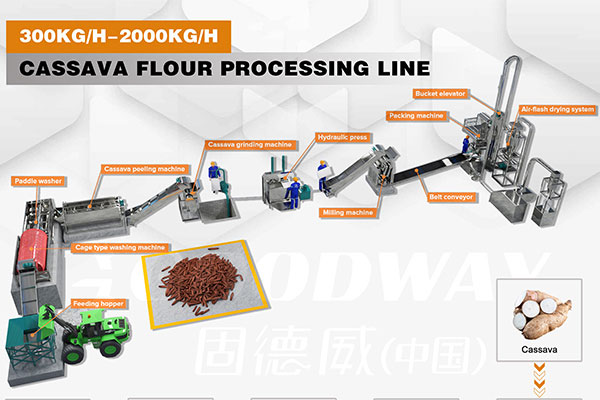
Goodway lists both cassava starch and flour as applications for its cassava drying machine, with published processing capacity of 100–2,000 kg/h.
The same dryer platform may therefore be suitable, but feed moisture, particle size and required final moisture should still be verified separately.
How to Compare Flash Dryer Energy Consumption
Flash-dryer energy consumption should be compared by water evaporated and finished output rather than by installed motor power alone.
Buyers should review:
Initial moisture: wetter feed increases heat demand.
Water evaporation rate: kg of water removed per hour is a useful comparison basis.
Heat source: steam, gas, biomass or another fuel changes operating cost.
Fan and motor power: electrical consumption rises with airflow and system resistance.
Insulation: poor insulation increases heat loss.
Heat efficiency: Goodway publishes thermal efficiency of up to 80% for its starch drying system.
A lower equipment price can therefore result in higher long-term cost if the dryer consumes more fuel or electricity per ton of finished starch.
How to Choose a Flash Dryer Supplier or Manufacturer
Reliable china air flash dryer suppliers should verify feed properties, evaporation load, heat source and required product moisture before recommending a model.
Before requesting a quotation, provide:
wet-feed rate in kg/h;
initial and target moisture;
starch type;
operating hours per day;
available steam, gas or other heat source;
local voltage and frequency;
installation-space limits;
required automation and dust collection.
Goodway's current models range from 300 to 2,000 kg/h finished output, with published motor power from 13 to 60 kW depending on model. Buyers comparing china air flash dryer suppliers should therefore compare complete operating conditions rather than output rating alone.
Conclusion
Sizing a starch flash dryer requires more than choosing a nominal kg/h model. Feed moisture determines evaporation load, while temperature, airflow, residence time and heat efficiency determine whether the system can reach the required final moisture consistently.
The most reliable selection process starts with wet-feed data, calculates water removal, then checks dryer capacity and energy demand against actual factory conditions.
FAQ About Starch Flash Dryer Selection
What moisture should wet starch have before flash drying?
Goodway specifies standard wet-starch input around 35–40% moisture for its system.
What final moisture can a flash dryer achieve?
Goodway publishes approximately 12–14%, with several models rated at ≤13%.
How long does starch stay in a flash dryer?
Typical contact time is very short; Goodway publishes approximately 1–5 seconds.
Is higher inlet temperature always better?
No. Higher temperature increases drying potential, but product quality, feed rate and residence time must be considered together.
What determines flash dryer energy use?
Initial moisture, evaporation load, airflow, heat source, insulation and thermal efficiency are the main factors.
 EN
EN
 fr
fr  es
es  it
it  pt
pt