Why do freshly produced glass noodles need cooling and aging before they are ready for further processing? The answer lies in the behavior of starch after gelatinization. During cooling, starch molecules gradually reorganize and form a more structured gel network. This process influences noodle firmness, elasticity, stickiness, and cooking stability. Understanding the starch noodle aging process helps manufacturers optimize production conditions and achieve more consistent product quality.
Why Freshly Extruded Vermicelli Needs Cooling and Setting
Freshly extruded vermicelli contains gelatinized starch and water. Immediately after extrusion, the strands may be relatively soft and structurally unstable.
Cooling allows the starch gel to lose heat and begin developing a more stable internal structure. This helps the strands maintain their shape during subsequent handling.
The main purposes of cooling include:
Reducing the temperature of freshly formed noodles.
Allowing the starch gel to develop structural stability.
Reducing excessive deformation during handling.
Preparing the strands for subsequent processing stages.
For extrusion-based production, cooling conditions should match the starch formulation, moisture content, and extrusion process.
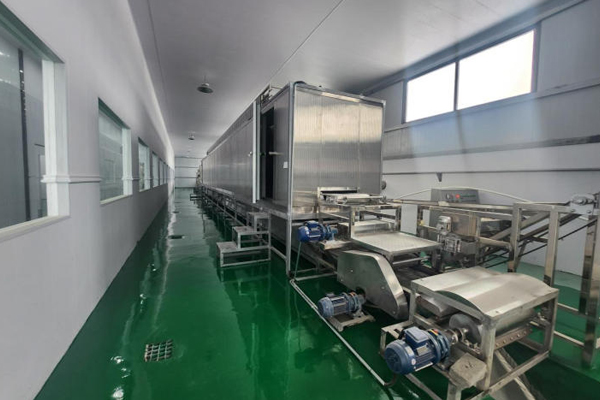
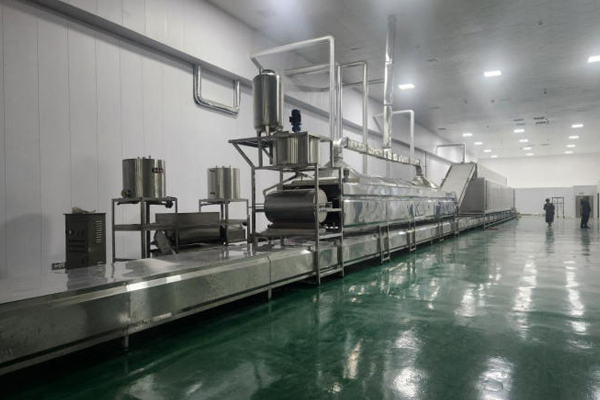
Goodway's extrusion-type vermicelli line provides an industrial production-line example for manufacturers evaluating extrusion-based vermicelli processing.
How Coating-Type Lines Cool Starch Sheets Before Cutting
Not all glass noodles are produced through direct extrusion of finished strands. Some production methods first form starch sheets and then process them into noodle strips.
In a coating-type process, starch material is spread into a relatively uniform layer before heating and subsequent cooling.
The cooling stage helps the gelatinized sheet develop sufficient structure for handling, separation, and cutting.
The general sequence includes:
Preparing and distributing the starch material.
Forming a continuous starch sheet.
Heating to achieve the required gelatinization.
Cooling the sheet to develop structural stability.
Separating and cutting the sheet into noodle strips.
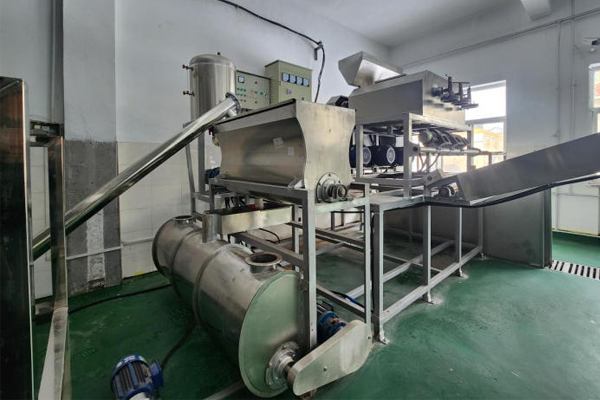
Goodway's automatic coating-type vermicelli line is relevant to this production route.
Compared with extrusion, coating-based production involves a different forming method. Therefore, cooling arrangements and processing requirements should not automatically be transferred from one production line to another.
What Happens to the Starch Network During Aging
Starch retrogradation is the process in which gelatinized starch molecules gradually reassociate and develop more ordered structures during cooling and storage.
When starch is heated with sufficient water, its granular structure changes during gelatinization. Starch molecules become more mobile and contribute to the formation of a gel network.
As the material cools, some amylose molecules reassociate relatively quickly, while amylopectin can reorganize over a longer period.
These changes influence the physical properties of the noodle structure:
The gel network can become firmer.
Molecular organization can increase.
Water distribution within the starch matrix can change.
Noodle elasticity and resistance to deformation can be affected.
Research published in 2025 on potato starch noodles found that freezing temperature influenced starch retrogradation, microstructure, and texture. This demonstrates that temperature management is an important factor in noodle structure development.
However, the response depends on the starch source and processing conditions.
Why Aging and Drying Perform Different Jobs on a Vermicelli Line
Cooling and aging are not the same as drying, even though all three can occur after noodle formation.
| Process | Main Function | Main Effect |
|---|
| Cooling | Removes heat | Reduces product temperature |
| Aging | Allows starch structure to reorganize | Changes gel strength and texture |
| Drying | Removes moisture | Reduces final product moisture |
Aging is mainly concerned with structural development, while drying is concerned with moisture removal.
For example, freshly formed wet noodles may require cooling and structural setting before entering another processing stage. If the production route includes drying, moisture reduction takes place separately.
Confusing these processes can lead to unsuitable production conditions. A noodle may be sufficiently cooled without being fully aged, and a dry noodle is not necessarily one that has undergone an optimal retrogradation process.
The sequence and duration of each stage depend on the intended product and manufacturing method.
How Starch Source Changes Cooling and Aging Requirements
Different starch sources do not behave identically during gelatinization and retrogradation.
Amylose content, amylopectin structure, starch purity, and water availability can influence the way a noodle develops its texture.
For example:
Mung bean starch: Commonly used in traditional glass noodles and associated with characteristic noodle structure.
Potato starch: Can produce a different gel texture and respond differently to temperature treatment.
Cassava starch: Offers different functional properties that must be considered when developing noodle formulations.
Research on mung bean starch glass noodles has demonstrated that incubation time and temperature can influence texture, cooking loss, and resistant starch formation.
Consequently, manufacturers should not apply a single aging schedule to all starch-based noodles.
How Cooling and Aging Affect Sticking, Breakage and Cooking Quality
A well-controlled cooling and aging process can help manufacturers manage several important quality characteristics.
Sticking: Adequate structural setting may help strands maintain their shape and reduce handling difficulties. However, surface moisture and formulation also influence sticking.
Breakage: A more developed starch network can improve structural integrity, although excessive firmness or unsuitable processing conditions may also make noodles less flexible.
Cooking loss: Retrogradation can reduce the release of soluble starch under certain conditions, helping improve cooking stability. The actual result depends on the formulation and aging conditions.
Texture: Cooling and aging influence firmness, elasticity, and chewiness. The desired balance depends on the target noodle product.
A 2025 study of mung bean starch glass noodles investigated incubation conditions and reported relationships between retrogradation, texture, and cooking loss.
These findings support the importance of process control, but laboratory results should not be treated as universal production settings.
Why Aging Conditions Must Match the Forming Process
There is no universal aging temperature or duration for every glass noodle production line.
The appropriate conditions depend on several interacting factors:
Starch source and formulation.
Initial moisture content.
Extrusion or coating method.
Product thickness and dimensions.
Cooling rate and storage temperature.
Desired final texture and cooking characteristics.
Some manufacturing routes use controlled refrigeration or freezing, while others rely on different cooling and setting arrangements.
Excessively long aging is not automatically beneficial. Over-processing may change noodle firmness, moisture distribution, and cooking behavior in undesirable ways.
Manufacturers should therefore validate cooling and aging conditions using product-specific trials rather than copying parameters from unrelated starch formulations.
Conclusion
Cooling and aging play important roles in developing the structure and texture of glass noodles. Cooling removes heat from freshly formed starch material, while retrogradation allows starch molecules to reorganize and strengthen the gel structure.
These changes can influence sticking, breakage, elasticity, and cooking performance. However, the ideal conditions depend on starch composition and the forming process.
For manufacturers, understanding the difference between cooling, aging, and drying provides a better foundation for designing and managing consistent vermicelli production.
FAQs
Why are glass noodles aged after forming?
Aging allows gelatinized starch molecules to reorganize and develop a more stable gel structure.
What is starch retrogradation?
It is the reassociation and ordering of gelatinized starch molecules during cooling and storage.
Is cooling the same as aging?
No. Cooling removes heat, while aging involves structural changes in the starch network.
Do all glass noodles need freezing?
No. Freezing is used in some production methods, but it is not a universal requirement.
Does longer aging always improve noodle quality?
No. Excessive aging can produce undesirable changes in firmness and cooking performance.
Does starch type affect vermicelli aging?
Yes. Amylose content and starch structure influence retrogradation and final noodle texture.
 EN
 fr
 es
 it
 pt